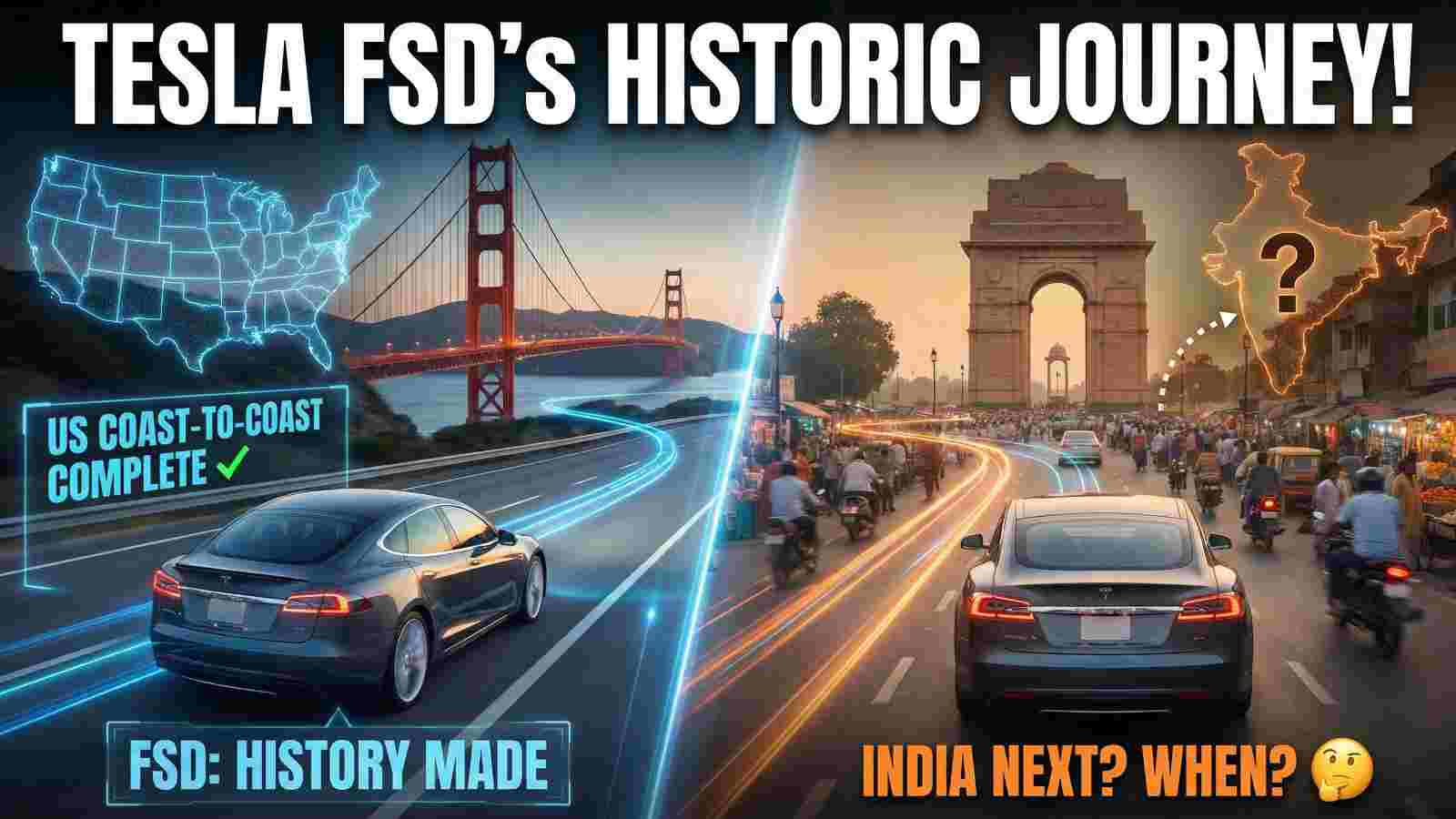
Tesla FSD Makes History: First True Driverless Coast-to-Coast Journey in the US — When Will This Technology Reach India?
Tesla has once again pushed the boundaries of autonomous driving. In a historic milestone, Tesla’s Full Self-Driving (FSD) system has reportedly completed a coast-to-coast journey across the United States without human intervention, marking a major leap toward fully autonomous transportation.
This achievement has reignited global discussions around self-driving technology — especially in countries like India, where interest in autonomous vehicles is growing rapidly.
What Exactly Did Tesla Achieve?
Tesla’s Full Self-Driving system successfully navigated a multi-state, coast-to-coast route across the US with:
- No human steering input
- No manual braking or acceleration
- Autonomous handling of highways, city roads, traffic signals, and complex intersections
Unlike earlier assisted-driving demonstrations, this journey highlights near-Level 4 autonomous behavior in real-world conditions.
While Tesla still classifies FSD as supervised in official documentation, this run represents one of the most advanced real-world demonstrations of autonomous driving to date.
Why This Moment Matters Globally
This achievement is significant for three key reasons:
1. Proof of Scalability
Autonomous systems often perform well in limited zones. A coast-to-coast drive proves Tesla’s AI can adapt across different road types, traffic patterns, and weather conditions.
2. AI-First Approach Is Paying Off
Unlike competitors that rely heavily on expensive sensors, Tesla’s camera-based AI model continues to improve using real-world data from millions of vehicles.
3. Regulatory Pressure Will Increase
Successful demonstrations accelerate pressure on governments worldwide to update laws around autonomous vehicles.
How Close Is Tesla to Fully Driverless Cars?
Tesla’s FSD is still officially considered Level 2 autonomy, meaning driver supervision is legally required. However, milestones like this suggest Tesla is technically approaching Level 4 capabilities, at least in controlled environments.
The remaining hurdles are no longer just technological — they are legal and regulatory.
When Could Tesla FSD Come to India?
This is the big question for Indian consumers.
Current Reality in India
- No Level 4 or Level 5 autonomous vehicles are legally allowed
- Indian traffic conditions are highly unpredictable
- Road infrastructure lacks uniform lane discipline
Challenges Tesla Faces in India
- Mixed traffic (pedestrians, animals, two-wheelers)
- Lack of autonomous-friendly regulations
- Data localization and compliance rules
Realistic Timeline
Experts believe:
- Advanced ADAS (Level 2–3) will expand in India by 2026–2027
- Limited autonomous trials may begin in controlled zones after 2028
- True driverless vehicles are unlikely before 2030+
Tesla FSD in India would require major policy changes, not just software updates.
What This Means for the Future of Mobility
Tesla’s coast-to-coast autonomous drive is not just a headline — it’s a signal.
- Autonomous vehicles are no longer experimental
- AI-driven driving systems are improving faster than expected
- The gap between developed markets and emerging markets may widen
For India, this moment serves as a preview of what’s coming, not what’s immediately available.
Final Thoughts
Tesla’s historic driverless coast-to-coast journey in the US marks a turning point in the autonomous driving race. While India may not see this technology on public roads anytime soon, the direction is clear: self-driving cars are moving from possibility to inevitability.
FAQs: Tesla FSD and Self-Driving Cars
Q1. Is Tesla FSD fully driverless?
Tesla FSD is still officially classified as supervised driving, but recent demonstrations show near-autonomous capability in real-world conditions.
Q2. Has Tesla completed a driverless coast-to-coast drive?
Yes, Tesla FSD has reportedly completed a coast-to-coast journey in the US without human intervention, marking a major milestone.
Q3. Is Tesla FSD legal in India?
No, self-driving cars are not currently legal on Indian public roads.
Q4. When will self-driving cars come to India?
Experts believe limited autonomous trials may begin after 2028, while full adoption could take longer.
Q5. Why is self-driving difficult in India?
Unpredictable traffic, mixed road usage, infrastructure gaps, and regulatory challenges make autonomous driving complex in India.